
Thor's Forgotten MCU Weapon Is Finally Getting the Credit It Deserves

This article contains spoilers for Jane Foster & the Mighty Thor #1.

Marvel Comics has brought back a forgotten weapon from Thor: The Dark World - and shown just how dangerous it could truly be. Released in 2013 as the second film in the MCU's Phase 2, Thor: The Dark World is generally considered one of the weakest films in the franchise. Its critic score on review aggregate site Rotten Tomatoes sits at a mere 66 percent, in large part because of its inherent weaknesses in direction and characterization.

For all that's the case, though, Marvel Comics has been trying to fix one of the MCU's worst films. Jason Aaron's "War of the Realms" transformed its villain Malekith into a terrifying threat, one who came close to conquering the Nine Realms. Meanwhile, Jane Foster has been given agency in a battle against forces that seemed rather similar to the MCU's Aether. It's often felt as though comic book writers took the movie as something of a dare, to see if they could find a way to make its disparate ideas work.

Related: Hulk & Thor's Power Proves Iron Man Isn't On The Same Level

The latest example is in Torunn Gronbekk and Ryan Stegman's Jane Foster & the Mighty Thor #1, in which Asgard's enemies launch an attack on the Realm Eternal - after first stripping Asgard of its greatest defender, Thor himself. The Dark Elves launch the first strike, hovering over Asgard and releasing singularity bombs that consume anything they encounter. Readers will find them very familiar indeed, because these were used by the Dark Elves in Thor: The Dark World. The key difference, however, is one of scale; in Jane Foster & the Mighty Thor #1, these singularity bombs can consume massive chunks of buildings. They're a far more chilling weapon.
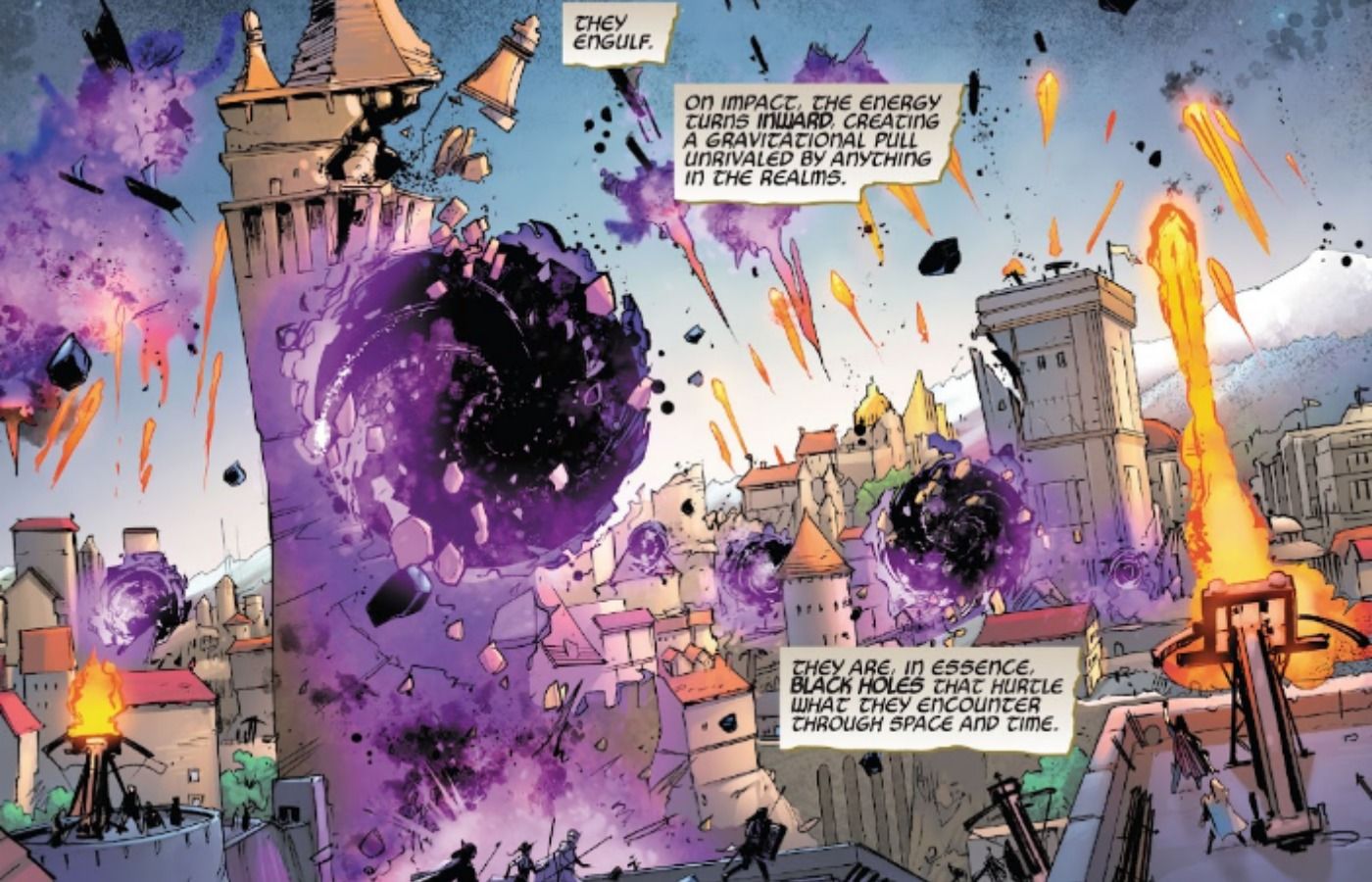
Marvel Comics has fixed another part of Thor: The Dark World. The MCU's singularity bombs were essentially hand-grenades, tossed at an enemy and creating a localized implosion. But the ones seen in the comics are massive weapons, obliterating swathes of Asgard. There's no defending against them, because when they strike a structure they destabilize it, bringing it down. Armed with these singularity bombs, the Dark Elves truly do feel like a threat to all Asgard.

This, frankly, is how the Dark Elves should have been in the MCU; a marauding force who reveled in destruction, causing mayhem on Asgard even as they pressed in to obtain the Aether. The Dark Elf leader Malekith is a far greater enemy to Asgard here, simply because he wants revenge and is delighted at the chance to get it. Ironically, Marvel Studios originally considered giving Malekith a similar personal vendetta against Asgard as well, but the key scenes were cut from the final theatrical release - although some of them can now be watched on Disney+'s deleted scenes.

All in all, Jane Foster & the Mighty Thor #1 really does feel like a reminder that Thor: The Dark World really did have so much more potential.

More: Hulk's New God-Powered Form Is Officially Replacing Thor


Comments

Popular posts from this blog

CBS' Ghosts: Every Main Ghost Time Period & Backstory Explained

One of CBS' newest sitcoms,  Ghosts , features a cast full of spectral characters that each hail from a distinct time period and come with their own unique backstory and death. Though each of the eight ghosts has a wildly different perspective based on their different experiences throughout history, they nonetheless form a sort of family, which is one of the show's greatest charms. After all, being stuck with the same people for all of eternity allows for plenty of time to get to know each other. Ghosts , which is an adaptation of a BBC show of the same name, stars Utkarsh Ambudkar and Rose McIver (who played Liv Moore on five seasons of  iZombie ) as Jay and Sam, a young couple who inherit a mansion in upstate New York. To their surprise, however, the house also comes with several ghostly inhabitants, who Sam is able to see after a near-death experience. These are Thorfinn (Devan Long), Sasappis (Román Zaragoza), Isaac (Brandon Scott Jones), Hetty (Rebecca Wisocky...

The Hateful Eight's Original Ending Explained (& Why Tarantino Changed It)

The Hateful Eight has an ending full of blood and betrayal, as expected from any Quentin Tarantino movie, but this wasn’t the original ending – here’s why he changed it. Tarantino has explored different genres throughout his career; though he’s best known for his crime movies like Reservoir Dogs and Pulp Fiction , he's also visited genres like martial arts (with both Kill Bill  films) and black comedy ( Once Upon a Time in Hollywood ). In addition, he's shared his version of westerns with Django Unchained and The Hateful Eight , with the latter going through some problems and creative changes even before it began shooting. Set in 1870, Tarantino's The  Hateful Eight follows eight strangers, all with different (and secret) motivations, who end up in a stagecoach lodge after seeking refuge from a blizzard. These characters are Major Marquis Warren (Samuel L. Jackson), John “The Hangman” Ruth (Kurt Russell), Daisy Domergue (Jennifer Jason Leigh), Chris Mannix (Walton Gog...

Why Spider-Man 3's Uncle Ben Retcon Doesn't Change Peter's Origin

Sam Raimi’s Spider-Man 3 is often criticized for a major retcon made to Uncle Ben’s death , but this retcon ultimately doesn’t change Peter Parker’s classic origin story. Raimi’s third film in the iconic Spider-Man trilogy is often criticized, perhaps unfairly. While the film suffers from too many character arcs and plot threads and would have been better as two or three separate films, it does a more than adequate job adapting the Spider-Man comics and telling a sincere story about relatable, flawed, characters who are intertwined with the extraordinary, just as Stan Lee and Steve Ditko intended when co-creating the character. Uncle Ben’s retconned death may alter classic elements from the comic version, but it retains its most important aspects in regards to Peter’s characterization. 2002’s Spider-Man is, for much of the film’s first half, a faithful adaptation of Spider-Man’s 1962 origin story in issue 15 of the Amazing Fantasy comics. An awkward social pariah, Pete...