
Throughout The Walking Dead franchise, the comic series has explored nearly every potential scenario surrounding a zombie apocalypse which wasn’t limited to the undead themselves, as humans, not zombies, proved to be the deadliest monsters in the series. However, there is one aspect of the saga that was briefly teased and then completely ignored–a secret ability exhibited by the titular walkers themselves.
The Walking Dead primarily follows a character named Rick who awakens from a coma to find that the world around him had been thrown into chaos. A zombie outbreak occurred while Rick was unconscious which swiftly crippled society, forcing humans to live in small factions to survive, some of which were incredibly violent and corrupt. After reuniting with his family, who had aligned themselves with a number of other survivors, Rick quickly steps in as the group’s leader given his relevant experience in law enforcement. While traveling through the world of the undead, Rick and his crew come across a fairly established civilization led by a name known as the Governor, though this seemingly hopeful sign of good fortune quickly devolved into a living nightmare.
In The Walking Dead #29 by Robert Kirkman, Charlie Adlard, and Cliff Rathburn, the Governor has Rick, Glenn, and Michonne held captive and is torturing them for information on where they came from after initially seemingly incredibly welcoming upon their initial introduction a few issues prior. After brutally assaulting Michonne then physically and psychologically tormenting Glenn, the Governor goes back to his house where his daughter was waiting for him. The thing is, though, the Governor's daughter is a zombie and the second he walks through the door, she attacks him in an attempt to take a juicy bite out of his living flesh. While this should come as no surprise given the fact that she’s a zombie, the Governor is taken aback, saying, “You haven’t tried to attack me in months,” but then he realized her bucket of food (human remains) was nearly empty, concluding that to be the reason behind her attempted assault.
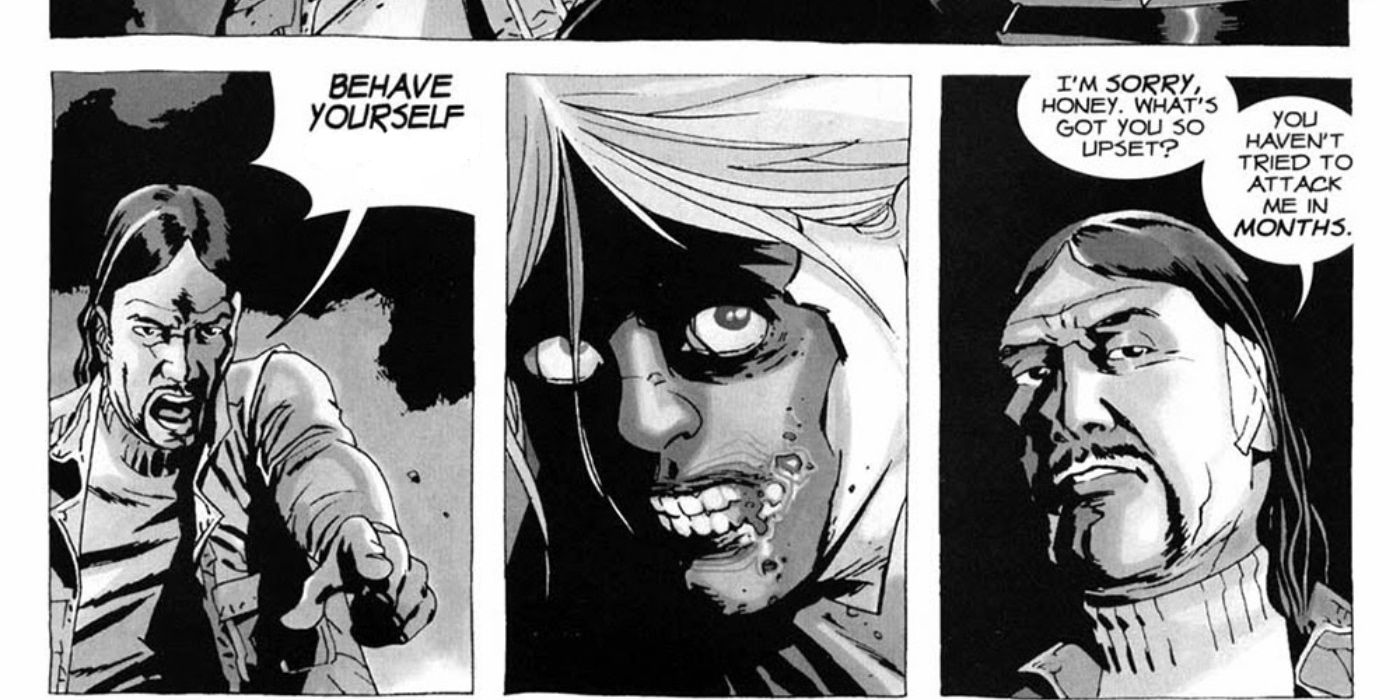
This interaction between the Governor and his undead daughter implies that zombies are more than just empty husks of endless hunger and pure aggression, but that they can actually learn. The fact that the Governor’s daughter hasn’t attacked him in months prior to the events of this issue means that she understood that as long as the Governor was around, there would be an endless supply of food in her bucket. It was only when she ran out of food that the little zombie girl saw the Governor himself as food, coming to the conclusion that he can either supply sustenance or become it.
While it is possible that the bucket of human body parts was simply a constant distraction for the Governor’s zombie daughter and she wasn’t actually learning anything, that seems unlikely given how zombies have always been portrayed in The Walking Dead as well as other zombie movies, shows, or books in existence. When a zombie sees fresh meat, even while they are in the middle of chewing on a corpse, they will stop what they’re doing and go after it as their drive to kill and eat overtakes them. The Governor said his daughter hadn’t attacked him in months, which doesn’t make any sense unless his undead daughter was, in fact, learning–a secret ability present in zombies that was hinted at in this issue of The Walking Dead, and then never explored again.
Comments
Post a Comment