
Wolverine's Healing Factor is Matched By Marvel's Scariest Villain

Marvel's Wolverine has a potent healing factor that allows him to recover from nearly any attack, but the X-Men's scariest villain can completely ignore this mutation in a horrifying manner. Logan has fought for well over a century in many major historical conflicts and still manages to recover from "mortal" wounds that would easily kill any ordinary human. But even though Wolverine is neither human nor ordinary, he can still succumb to the dark X-Men villain Cassandra Nova.

The power of Wolverine's healing factor has fluctuated over the decades. When he first appeared in 1975, Logan was able to easily recover from cuts, bruises, and multiple gunshot wounds, even in vital areas. In the modern era, he can walk through fire, survive grenade explosions, and even survive a nuclear blast (though the upper limits are seen in the Ultimate X-Men series, in which Wolverine can miraculously regenerate from a single cell). But some villains like Magneto have complete control over his adamantium body - and others, like Cassandra Nova, are simply too strong for him to fight.

Related: X-23 Learns The Tragic Cost Of Being Wolverine

In New X-Men #116, the X-Men headquarters is infiltrated by Cassandra Nova after a devastating attack on all mutantkind. Nova decides to repay in kind, and proceeds to attack Cyclops, Jean Grey, Beast and Professor X. Wolverine moves to attack Cassandra but he is shockingly repelled; Nova strips away the skin and muscle of his entire arm, leaving only his adamantium bones and sharp claws behind. She appears to erase his skin with very little effort as well, and Wolverine is putting his all into the fight.
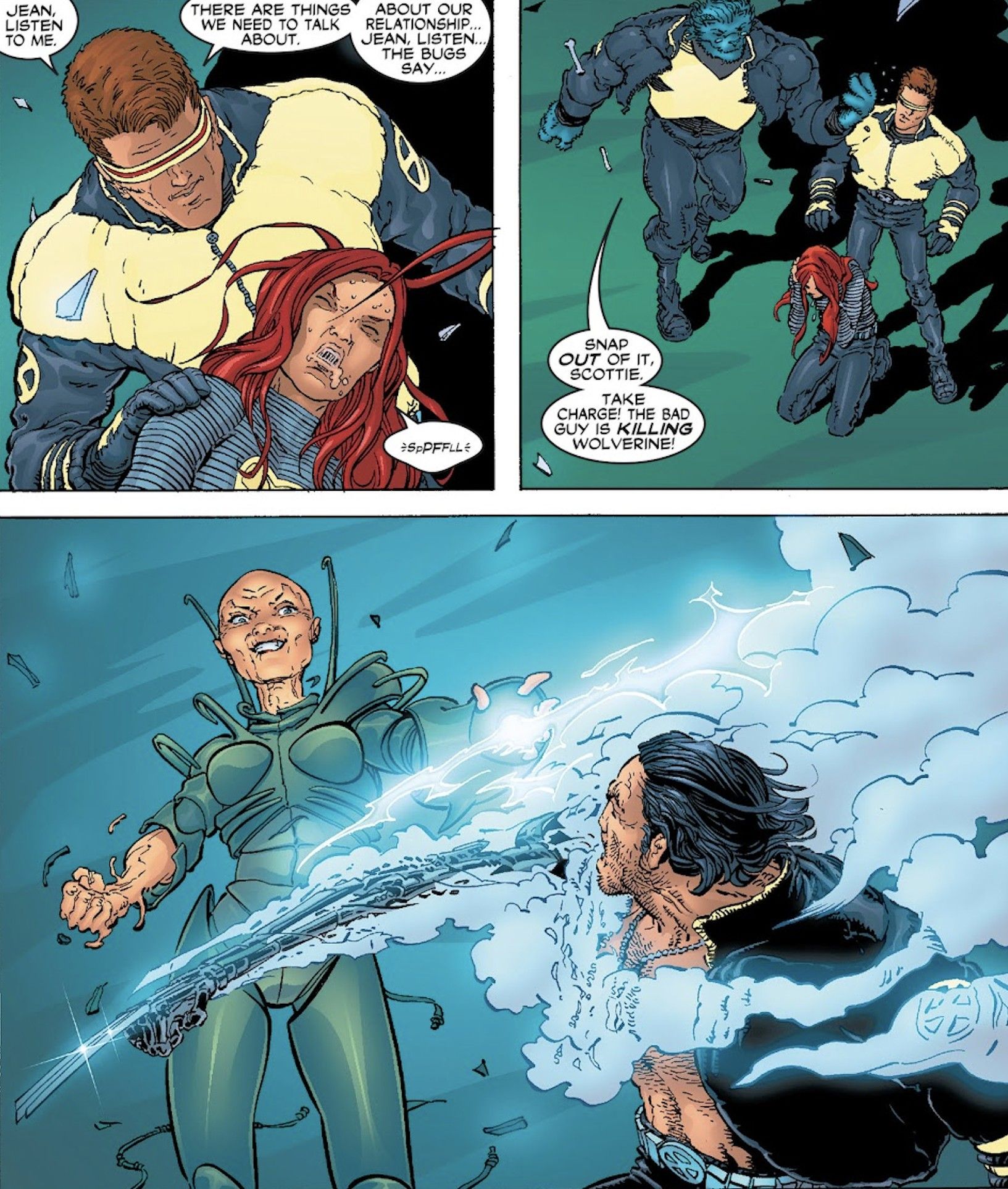
There are very few villains who can outright kill Wolverine, or at least prevent him from saving himself thanks to his power. Certain telepaths like Professor Xavier come to mind (although Wolverine's healing ability extends to his own mind, and has been shown to undo damage done by telepaths and intense past trauma). Cassandra Nova's offensive capabilities mean she can cause damage faster than Wolverine can heal. Since Wolverine is unfamiliar with Nova's abilities, this also constitutes as an ambush of sorts, leaving Wolverine shocked as well as defenseless.

Cassandra Nova is unceremoniously shot in the head by Professor X, ending the fight and the threat she presented. Wolverine, however, came remarkably close to death in the battle, however short it may have been. If Cassandra Nova decided to strip away the skin on Wolverine's chest (0r worse, use her powers to destroy his heart), Logan would most likely not have survived to fight another day.

Next: Wolverine's Darkest Story Chickened Out of Its Totally Valid Point


Comments

Popular posts from this blog

CBS' Ghosts: Every Main Ghost Time Period & Backstory Explained

One of CBS' newest sitcoms,  Ghosts , features a cast full of spectral characters that each hail from a distinct time period and come with their own unique backstory and death. Though each of the eight ghosts has a wildly different perspective based on their different experiences throughout history, they nonetheless form a sort of family, which is one of the show's greatest charms. After all, being stuck with the same people for all of eternity allows for plenty of time to get to know each other. Ghosts , which is an adaptation of a BBC show of the same name, stars Utkarsh Ambudkar and Rose McIver (who played Liv Moore on five seasons of  iZombie ) as Jay and Sam, a young couple who inherit a mansion in upstate New York. To their surprise, however, the house also comes with several ghostly inhabitants, who Sam is able to see after a near-death experience. These are Thorfinn (Devan Long), Sasappis (Román Zaragoza), Isaac (Brandon Scott Jones), Hetty (Rebecca Wisocky...

The Hateful Eight's Original Ending Explained (& Why Tarantino Changed It)

The Hateful Eight has an ending full of blood and betrayal, as expected from any Quentin Tarantino movie, but this wasn’t the original ending – here’s why he changed it. Tarantino has explored different genres throughout his career; though he’s best known for his crime movies like Reservoir Dogs and Pulp Fiction , he's also visited genres like martial arts (with both Kill Bill  films) and black comedy ( Once Upon a Time in Hollywood ). In addition, he's shared his version of westerns with Django Unchained and The Hateful Eight , with the latter going through some problems and creative changes even before it began shooting. Set in 1870, Tarantino's The  Hateful Eight follows eight strangers, all with different (and secret) motivations, who end up in a stagecoach lodge after seeking refuge from a blizzard. These characters are Major Marquis Warren (Samuel L. Jackson), John “The Hangman” Ruth (Kurt Russell), Daisy Domergue (Jennifer Jason Leigh), Chris Mannix (Walton Gog...

Why Spider-Man 3's Uncle Ben Retcon Doesn't Change Peter's Origin

Sam Raimi’s Spider-Man 3 is often criticized for a major retcon made to Uncle Ben’s death , but this retcon ultimately doesn’t change Peter Parker’s classic origin story. Raimi’s third film in the iconic Spider-Man trilogy is often criticized, perhaps unfairly. While the film suffers from too many character arcs and plot threads and would have been better as two or three separate films, it does a more than adequate job adapting the Spider-Man comics and telling a sincere story about relatable, flawed, characters who are intertwined with the extraordinary, just as Stan Lee and Steve Ditko intended when co-creating the character. Uncle Ben’s retconned death may alter classic elements from the comic version, but it retains its most important aspects in regards to Peter’s characterization. 2002’s Spider-Man is, for much of the film’s first half, a faithful adaptation of Spider-Man’s 1962 origin story in issue 15 of the Amazing Fantasy comics. An awkward social pariah, Pete...