
Black Panther Hints At The Darkest Secret of Wakanda Yet

Warning: contains spoilers for Black Panther #7!

Marvel's Black Panther may rule over Wakanda with benevolent intent, but the secretive country may hide more than simple advanced technology. The land has long been presented as a quasi-utopia in both comics and films; the highly-advanced Wakandan technology has allowed the country to defend itself from all outside invaders. But this power perhaps comes at a prince, and in Black Panther #7, both Marvel and Wakandans ask the all-important question: is Wakanda a police state?

Both T'Challa and his country first appeared in Fantastic Four #52 in 1961, in which Marvel's first family was invited to Wakanda by the King himself. There, the "African chieftain" (so named by Reed Richards) attacks the group and nearly manages to defeat them all, a testament to his fighting abilities and his knowledge of every member's powers. The attack was a test, and Black Panther allied himself with the Fantastic Four in an attempt to defeat Klaw, his feared rival (and the murderer of his father, the previous King T'Chaka).

Related: Marvel Imagines Wakanda Without Black Panther Ahead of MCU Sequel

In Black Panther #7, written by John Ridley with art by Stefano Landini, T'Challa has escaped the clutches of his assassins, who turned out to be lawful Wakandan warriors. In recent months, the nation of Wakanda has undergone a massive transition from an absolute monarchy into a democracy, which T'Challa does not appreciate. "The punishment for sedition is death," muses the leader of the secret police. "If necessary, I'll carry out the sentence myself." The fact that Wakandans still have the death penalty, despite living in an apparent utopia with no major health crises or resource shortages, proves the thing Wakandan leaders are most afraid of is losing their power.
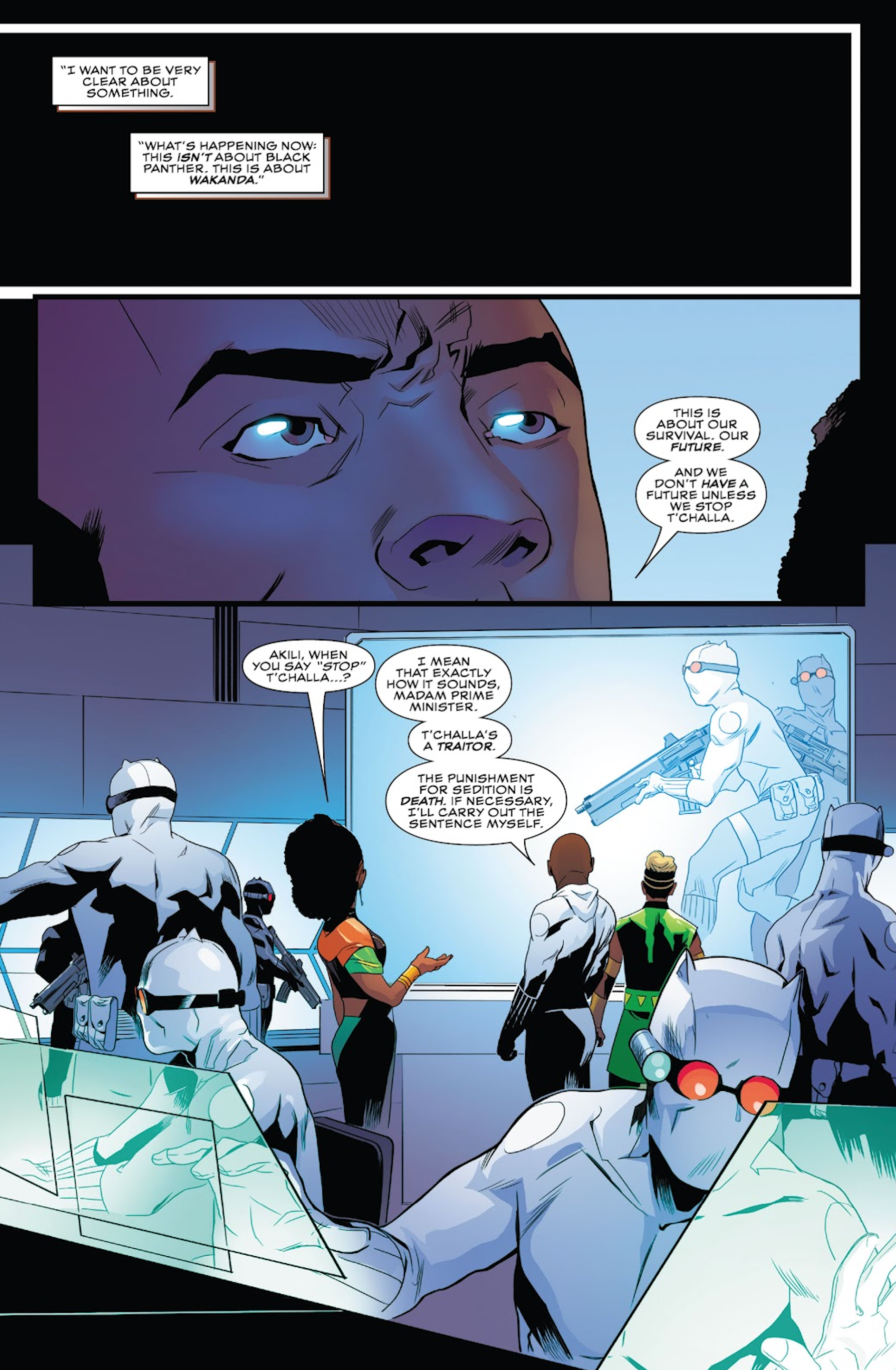
This is not the first time the Secret Police of Wakanda have been brought up in the story. Later on, Imani and the new Prime Minister of Wakanda walk the city streets after a tension-filled meeting. "Keep your voice down, Imani," warns the Prime Minister. "The Hatut Zeraze probably have eyes and ears on us." The Hatut Zeraze (Wakanda's secret police) surveils the entire country and certainly the capital city, and the organization was previously led by T'Challa's white adopted brother Hunter, who later became the White Wolf.

The fact that T'Challa's own brother - adopted or otherwise - was allowed to run such a powerful organization suggests the monarchy was not as secure as citizens believed it to be. While Hunter was overzealous in his protection of the country, the Hatut Zeraze continue to function, and the organization would not be out of place in a Soviet-era government. Black Panther's nation of Wakanda might not have the problems of the Western of European powers, but it is certainly no utopia either.

Next: New Wakanda Forever Reveal Supports Shuri As New Black Panther Theory

Black Panther #7 is available now from Marvel Comics.


Comments

Popular posts from this blog

CBS' Ghosts: Every Main Ghost Time Period & Backstory Explained

One of CBS' newest sitcoms,  Ghosts , features a cast full of spectral characters that each hail from a distinct time period and come with their own unique backstory and death. Though each of the eight ghosts has a wildly different perspective based on their different experiences throughout history, they nonetheless form a sort of family, which is one of the show's greatest charms. After all, being stuck with the same people for all of eternity allows for plenty of time to get to know each other. Ghosts , which is an adaptation of a BBC show of the same name, stars Utkarsh Ambudkar and Rose McIver (who played Liv Moore on five seasons of  iZombie ) as Jay and Sam, a young couple who inherit a mansion in upstate New York. To their surprise, however, the house also comes with several ghostly inhabitants, who Sam is able to see after a near-death experience. These are Thorfinn (Devan Long), Sasappis (Román Zaragoza), Isaac (Brandon Scott Jones), Hetty (Rebecca Wisocky...

The Hateful Eight's Original Ending Explained (& Why Tarantino Changed It)

The Hateful Eight has an ending full of blood and betrayal, as expected from any Quentin Tarantino movie, but this wasn’t the original ending – here’s why he changed it. Tarantino has explored different genres throughout his career; though he’s best known for his crime movies like Reservoir Dogs and Pulp Fiction , he's also visited genres like martial arts (with both Kill Bill  films) and black comedy ( Once Upon a Time in Hollywood ). In addition, he's shared his version of westerns with Django Unchained and The Hateful Eight , with the latter going through some problems and creative changes even before it began shooting. Set in 1870, Tarantino's The  Hateful Eight follows eight strangers, all with different (and secret) motivations, who end up in a stagecoach lodge after seeking refuge from a blizzard. These characters are Major Marquis Warren (Samuel L. Jackson), John “The Hangman” Ruth (Kurt Russell), Daisy Domergue (Jennifer Jason Leigh), Chris Mannix (Walton Gog...

Why Spider-Man 3's Uncle Ben Retcon Doesn't Change Peter's Origin

Sam Raimi’s Spider-Man 3 is often criticized for a major retcon made to Uncle Ben’s death , but this retcon ultimately doesn’t change Peter Parker’s classic origin story. Raimi’s third film in the iconic Spider-Man trilogy is often criticized, perhaps unfairly. While the film suffers from too many character arcs and plot threads and would have been better as two or three separate films, it does a more than adequate job adapting the Spider-Man comics and telling a sincere story about relatable, flawed, characters who are intertwined with the extraordinary, just as Stan Lee and Steve Ditko intended when co-creating the character. Uncle Ben’s retconned death may alter classic elements from the comic version, but it retains its most important aspects in regards to Peter’s characterization. 2002’s Spider-Man is, for much of the film’s first half, a faithful adaptation of Spider-Man’s 1962 origin story in issue 15 of the Amazing Fantasy comics. An awkward social pariah, Pete...