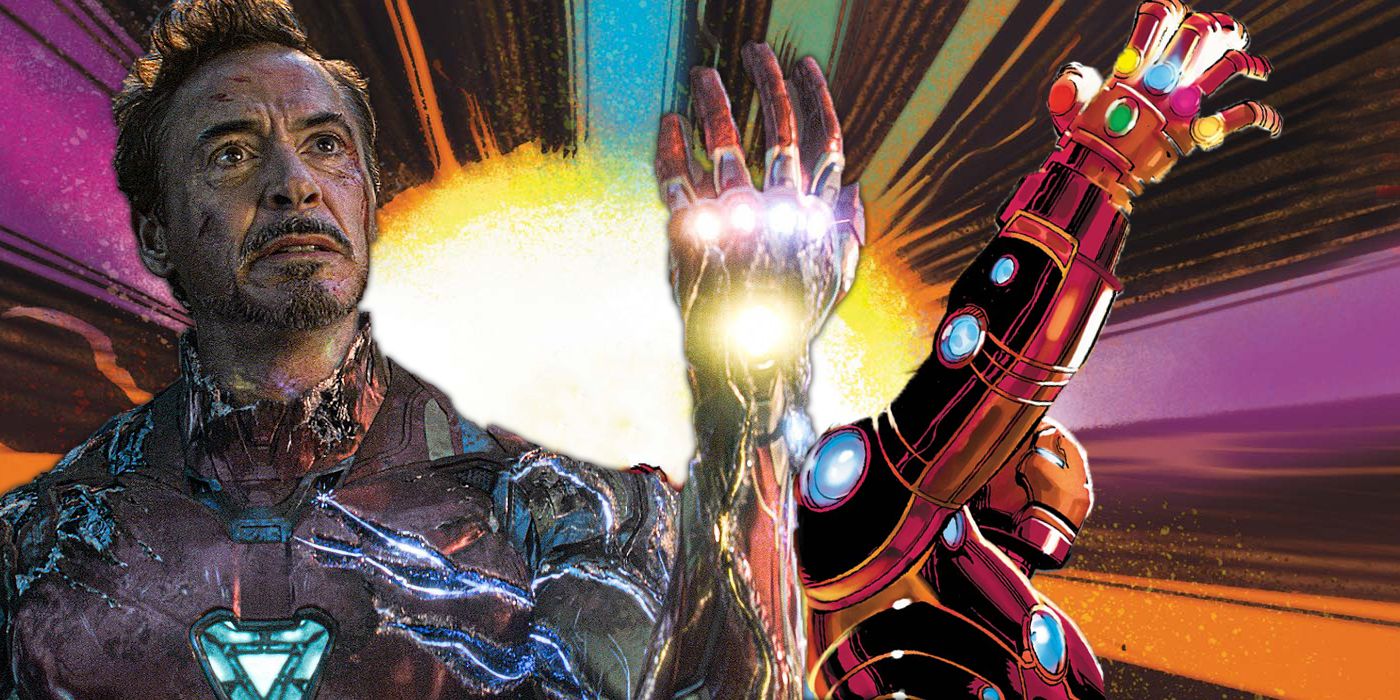
Iron Man's Infinity Gauntlet Moment Proves Tony Stark Is a Big Hypocrite

While Iron Man using the Infinity Gauntlet is an iconic moment in the MCU, in the comics it just proves how big of a hypocrite Tony Stark actually is. When the Avengers stop the villain Hood from collecting all the Infinity Stones, Iron Man briefly holds infinite power in his hand. His declarations at that moment, when compared to his future actions, show that Tony is Marvel's biggest hypocrite.

The Avengers got their first experience with the Infinity Stones during the iconic Infinity Gauntlet saga, when they found themselves in the middle of a war for absolute power over the universe, involving Thanos and Adam Warlock. Sometime after these cosmic events, the Illuminati, a secret cabal of the most influential superhumans on Earth, decided to collect the stones to keep them safe from evildoers. However, the villain Hood accidentally learned about their existence and poured all his resources into finding all the Infinity Stones. This forced the Illuminati to reveal their secret and alert the Avengers to try and stop Hood.

Related: Thanos Missed the Avengers’ Second Gauntlet Saga (Even If He Was There)

As a member of both the Avengers and the Illuminati, Iron Man was right in the middle of this battle for the future of existence in Avengers #12 from Brian Michael Bendis and John Romita Jr. In the climax of the fight, Tony gets all the stones and assembles the Infinity Gauntlet. When asked by the defeated Hood what he will do now, Iron Man makes a full speech. He says how he could make all the things he doesn't like go away, including war, drugs, and his past mistakes, but then he would stop the human race from advancing, taking away free will and the ability to learn. It all sounds really wise and smart, however, when years later Iron Man gets imbued with the Power Cosmic, becoming the all-powerful Iron God, he does exactly the opposite. He forcibly changes the people of Manhattan into Stark-level geniuses, imposing his vision of a "better world" on others, without their consent.
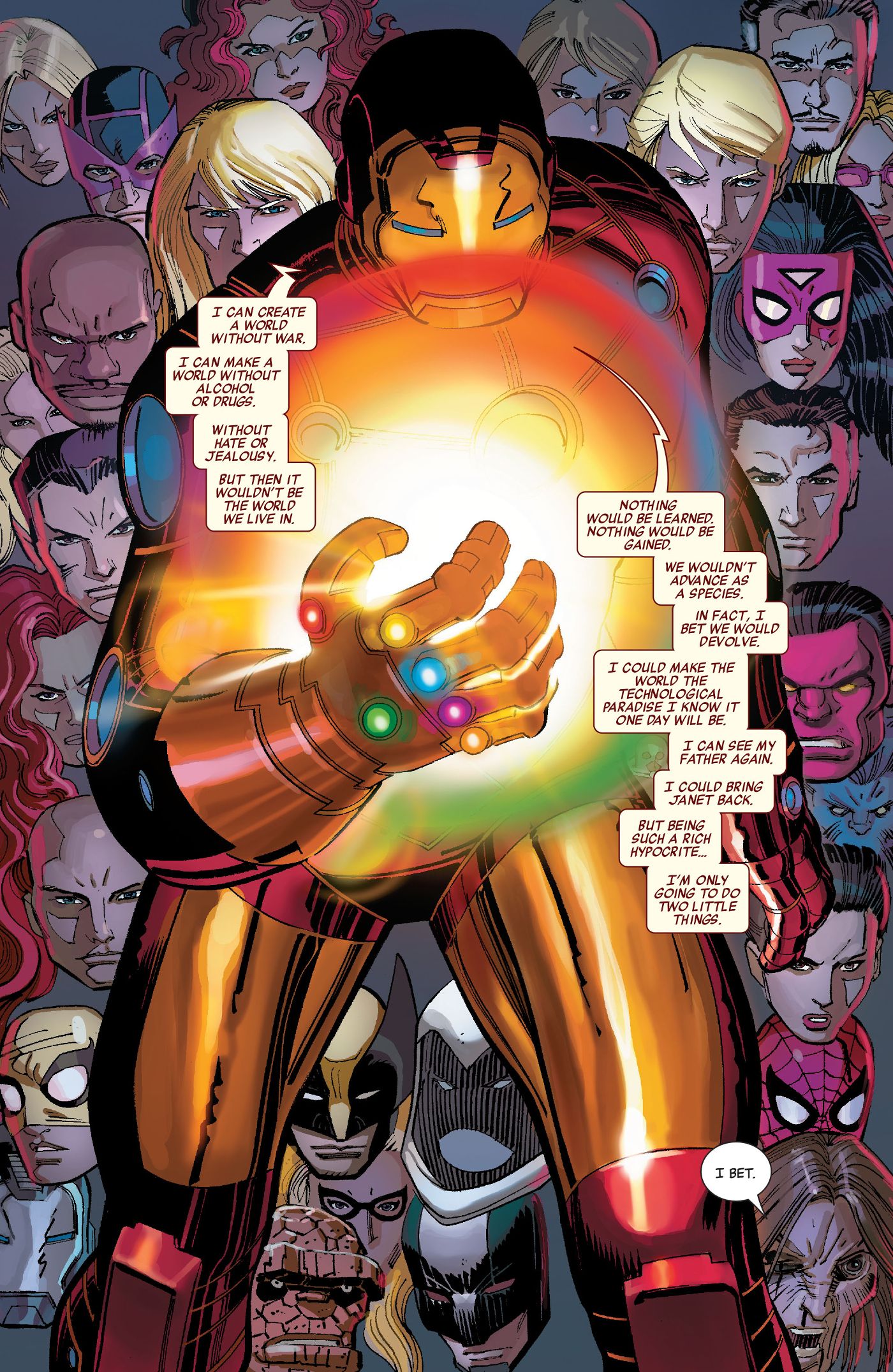
It is actually really surprising that the assembled Avengers believed Tony's Infinity Gauntlet speech. Over the course of the years, Iron Man has shown time and time again that he has a very flexible set of morals. He believes that the ends justify the means, and his morality and ethics are highly adaptable to what he considers the greater good of humankind and his own vision of progress. This attitude often led Iron Man into conflict with his fellow superhumans, especially Captain America, who has a strict moral code and adheres to it, no matter the circumstances. Tony's experience with the Power Cosmic simply proved that he cannot be trusted with absolute power, as he lacks the unbreakable and incorruptible spirit needed to handle such a responsibility.

Iron Man's Infinity Gauntlet moment in the MCU will always be remembered as a symbol of selflessness and sacrifice for the greater good. In the comics, instead, it just exposed how good Tony is at lying to his friends, as proved by the fact that, shortly after his speech, Iron Man pretended to destroy the Gauntlet while actually giving the stones to the Illuminati. Tony Stark's Infinity Gauntlet speech could have been his most heroic moment ever, instead, it just exposed how big of a hypocrite Iron Man actually is.

Next: Thanos Is the Secret 'Father' of Venom's Carnage Symbiote (No, Really)


Comments

Popular posts from this blog

CBS' Ghosts: Every Main Ghost Time Period & Backstory Explained

One of CBS' newest sitcoms,  Ghosts , features a cast full of spectral characters that each hail from a distinct time period and come with their own unique backstory and death. Though each of the eight ghosts has a wildly different perspective based on their different experiences throughout history, they nonetheless form a sort of family, which is one of the show's greatest charms. After all, being stuck with the same people for all of eternity allows for plenty of time to get to know each other. Ghosts , which is an adaptation of a BBC show of the same name, stars Utkarsh Ambudkar and Rose McIver (who played Liv Moore on five seasons of  iZombie ) as Jay and Sam, a young couple who inherit a mansion in upstate New York. To their surprise, however, the house also comes with several ghostly inhabitants, who Sam is able to see after a near-death experience. These are Thorfinn (Devan Long), Sasappis (Román Zaragoza), Isaac (Brandon Scott Jones), Hetty (Rebecca Wisocky...

The Hateful Eight's Original Ending Explained (& Why Tarantino Changed It)

The Hateful Eight has an ending full of blood and betrayal, as expected from any Quentin Tarantino movie, but this wasn’t the original ending – here’s why he changed it. Tarantino has explored different genres throughout his career; though he’s best known for his crime movies like Reservoir Dogs and Pulp Fiction , he's also visited genres like martial arts (with both Kill Bill  films) and black comedy ( Once Upon a Time in Hollywood ). In addition, he's shared his version of westerns with Django Unchained and The Hateful Eight , with the latter going through some problems and creative changes even before it began shooting. Set in 1870, Tarantino's The  Hateful Eight follows eight strangers, all with different (and secret) motivations, who end up in a stagecoach lodge after seeking refuge from a blizzard. These characters are Major Marquis Warren (Samuel L. Jackson), John “The Hangman” Ruth (Kurt Russell), Daisy Domergue (Jennifer Jason Leigh), Chris Mannix (Walton Gog...

Why Spider-Man 3's Uncle Ben Retcon Doesn't Change Peter's Origin

Sam Raimi’s Spider-Man 3 is often criticized for a major retcon made to Uncle Ben’s death , but this retcon ultimately doesn’t change Peter Parker’s classic origin story. Raimi’s third film in the iconic Spider-Man trilogy is often criticized, perhaps unfairly. While the film suffers from too many character arcs and plot threads and would have been better as two or three separate films, it does a more than adequate job adapting the Spider-Man comics and telling a sincere story about relatable, flawed, characters who are intertwined with the extraordinary, just as Stan Lee and Steve Ditko intended when co-creating the character. Uncle Ben’s retconned death may alter classic elements from the comic version, but it retains its most important aspects in regards to Peter’s characterization. 2002’s Spider-Man is, for much of the film’s first half, a faithful adaptation of Spider-Man’s 1962 origin story in issue 15 of the Amazing Fantasy comics. An awkward social pariah, Pete...