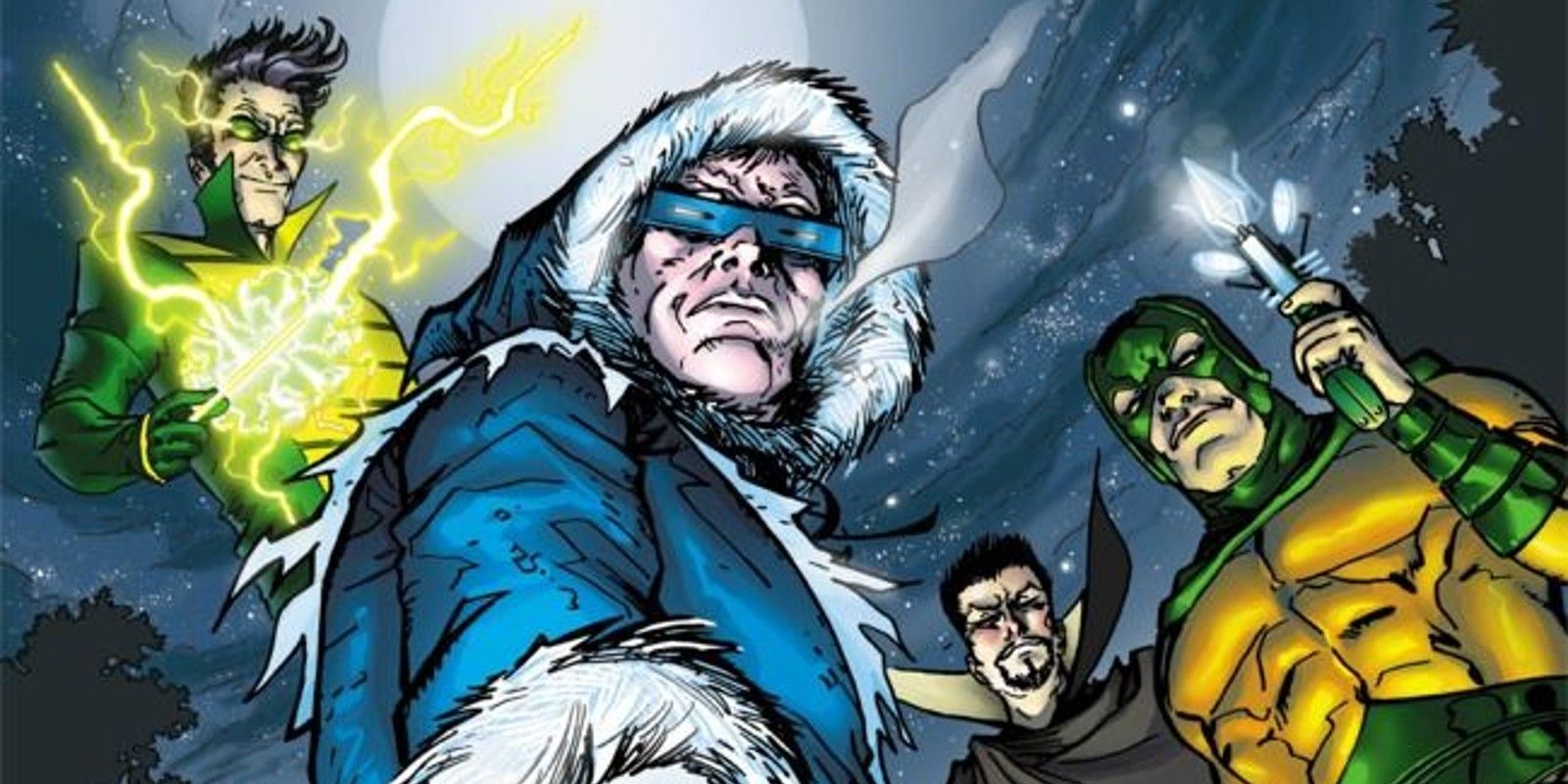
The Flash's Rogues Explode in A Brutal, Bloody Betrayal

Spoiler warning for Rogues #3

Despite their often light-hearted depictions, the Flash's iconic Rogues just turned against each other in a series of brutal and dark betrayals. The Rogues have been stalwart villains in the Flash family of books and across the DC Universe, but they've also been known for their willingness to reform and work with the Flash instead of against him. Now, in an imagined future created for the Rogues mini-series published in the Black Label imprint, DC shows its readers what would happen if these goofy villains were just as brutal as villains ought to be.

The Rogues have Silver Age origins, where they banded together for petty robberies and to battle Barry Allen's Flash. The roster occasionally changes, but generally their spirit and camaraderie remains the same: with brightly colored costumes, they tend to stick to robberies and only kill when necessary. In the Rogues series from DC Comics, the team, led by Captain Cold, has banded together for one last heist in Gorilla City. Much of the team has retired by choice or necessity, but Cold has convinced them the heist—Gorilla City has a rumored vault of gold—will be worth coming out of retirement. He has collected a team of classic and second-generation Rogues for the job, including Golden Glider, Magenta, and the second Trickster and Mirror Master.

Related: Flash Revealing His True Speed Proved Superman is a Jerk

The heist begins in earnest as of Rogues #3 by Joshua Williamson, Leomacs, Jason Wordie, and Hassan Otsmane-Elhaou, wherein the Rogues reach the rumored vault and find a double splash page's worth of gold bars. That's when things begin to go wrong. Captain Cold pushes Magenta to the absolute limit of her power, causing her death. Immediately afterwards, as the team attempts to escape the guards, a gorilla guard throttles Mirror Master—who tries to stop Cold and help Magenta—and breaks his neck. Most brutally, Golden Glider slits the Trickster's throat with the blade of her skate when she discovers he's kidnapped a baby gorilla—who just so happens to be the child of Gorilla Grodd himself.

One could argue that the deaths of Magenta and Mirror Master were not, technically, Captain Cold's fault, but Golden Glider without a doubt murders the Trickster, stretching the "only kill when necessary" Rogues rule to its furthest limit. Interestingly, Lisa Snart is the Rogue who is the "most reformed" of this particular group, working as a social worker in this new future. For her to turn against the Trickster is a true mark of how brutal things can get when the Rogues turn against each other, despite their claims to be more like family than a team of powered criminals. Of course, one of the thrills of DC's Black Label line is seeing creators' interpretations of these characters when divorced from true DC canon. Because of that freedom, fans can almost certainly expect more carnage in the next issue of Rogues.

The Rogues might sometimes be like family to each other, but that means their betrayals are far more brutal—and, in this case, bloody. The team has lost three of their own, almost all to each other's hands. What this means for the success of their heist—as well as their freedom and their familial bond—is yet to be seen, but the final issue of this noir-like Black Label series will certainly contain even more twists for the Flash's Rogues.

More: Nightwing's New Costume Has One Flaw Its Creator Would Never Allow

Check out Rogues #3 available now from DC Comics!


Comments

Popular posts from this blog

CBS' Ghosts: Every Main Ghost Time Period & Backstory Explained

One of CBS' newest sitcoms,  Ghosts , features a cast full of spectral characters that each hail from a distinct time period and come with their own unique backstory and death. Though each of the eight ghosts has a wildly different perspective based on their different experiences throughout history, they nonetheless form a sort of family, which is one of the show's greatest charms. After all, being stuck with the same people for all of eternity allows for plenty of time to get to know each other. Ghosts , which is an adaptation of a BBC show of the same name, stars Utkarsh Ambudkar and Rose McIver (who played Liv Moore on five seasons of  iZombie ) as Jay and Sam, a young couple who inherit a mansion in upstate New York. To their surprise, however, the house also comes with several ghostly inhabitants, who Sam is able to see after a near-death experience. These are Thorfinn (Devan Long), Sasappis (Román Zaragoza), Isaac (Brandon Scott Jones), Hetty (Rebecca Wisocky...

The Hateful Eight's Original Ending Explained (& Why Tarantino Changed It)

The Hateful Eight has an ending full of blood and betrayal, as expected from any Quentin Tarantino movie, but this wasn’t the original ending – here’s why he changed it. Tarantino has explored different genres throughout his career; though he’s best known for his crime movies like Reservoir Dogs and Pulp Fiction , he's also visited genres like martial arts (with both Kill Bill  films) and black comedy ( Once Upon a Time in Hollywood ). In addition, he's shared his version of westerns with Django Unchained and The Hateful Eight , with the latter going through some problems and creative changes even before it began shooting. Set in 1870, Tarantino's The  Hateful Eight follows eight strangers, all with different (and secret) motivations, who end up in a stagecoach lodge after seeking refuge from a blizzard. These characters are Major Marquis Warren (Samuel L. Jackson), John “The Hangman” Ruth (Kurt Russell), Daisy Domergue (Jennifer Jason Leigh), Chris Mannix (Walton Gog...

Why Spider-Man 3's Uncle Ben Retcon Doesn't Change Peter's Origin

Sam Raimi’s Spider-Man 3 is often criticized for a major retcon made to Uncle Ben’s death , but this retcon ultimately doesn’t change Peter Parker’s classic origin story. Raimi’s third film in the iconic Spider-Man trilogy is often criticized, perhaps unfairly. While the film suffers from too many character arcs and plot threads and would have been better as two or three separate films, it does a more than adequate job adapting the Spider-Man comics and telling a sincere story about relatable, flawed, characters who are intertwined with the extraordinary, just as Stan Lee and Steve Ditko intended when co-creating the character. Uncle Ben’s retconned death may alter classic elements from the comic version, but it retains its most important aspects in regards to Peter’s characterization. 2002’s Spider-Man is, for much of the film’s first half, a faithful adaptation of Spider-Man’s 1962 origin story in issue 15 of the Amazing Fantasy comics. An awkward social pariah, Pete...