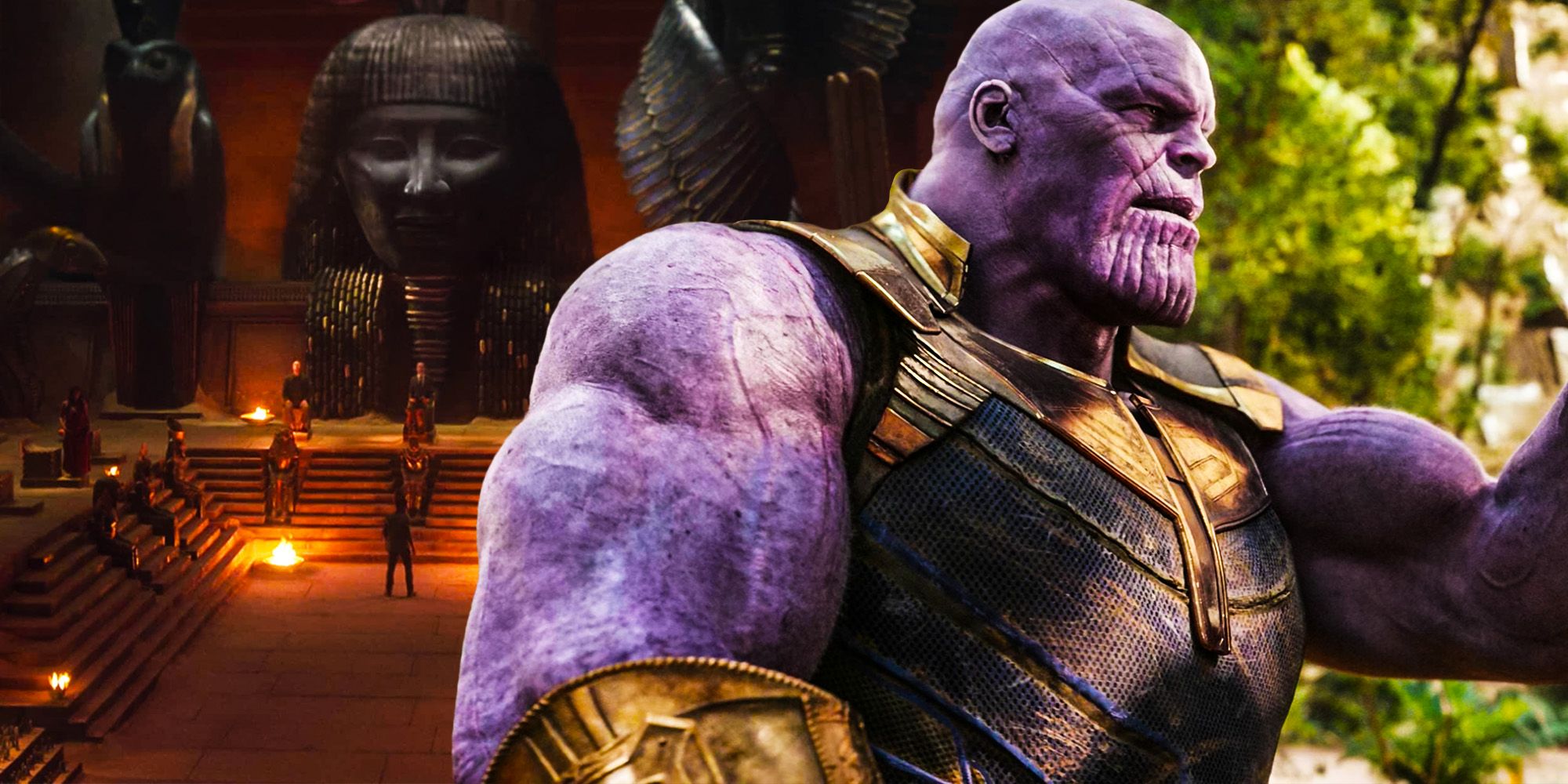
Why Moon Knight's Gods Didn't Stop Thanos In Infinity War

Warning: Spoilers for Moon Knight episode 3

The history of the MCU’s Egyptian gods in Moon Knight explains why they didn’t stop Thanos in Avengers: Infinity War. Marc Spector’s story in the Disney+ series has featured a deep look at a previously unseen corner of the MCU. Apparently, a new group of superhuman immortals – known as the Ennead – have been lurking in the universe for untold millennia.

Not long after introducing Khonshu and Ammit, Moon Knight brought Marc face-to-face with a handful of the MCU’s Egyptian gods. A secret meeting of the gods in Moon Knight episode 3 saw Khonshu use Marc’s body to convene with the avatars of Horus, Isis, Hathor, Osiris, and Tefnut in an effort to prevent Ethan Hawke’s Arthur Harrow from unleashing Ammit upon the world. What happened in the episode provided some much-needed details about the backstory of the MCU’s take on the Egyptian gods and Khonshu’s strained relationship with his fellow deities. But given that they’ve been around since the days of the ancient Egyptians, there’s of course a lot to be explored about this secret group and what else they’ve been involved in over the years.

Related: Moon Knight’s Missing Gods Could Tease Thor: Love & Thunder’s Villain

At least one major question pertaining to the Egyptian gods was seemingly answered in Moon Knight episode 3, which relates to their absence in Avengers: Infinity War. It was said during the meeting that the gods have chosen to stay out of the affairs of mankind. It would seem that this started when the humans “abandoned” them, which is likely a reference to the fact that the gods aren’t worshipped by the Egyptians anymore. As a result, only some of the gods still remain on Earth, and the ones who are still around act solely as observers. That makes sense of why the Egyptian gods didn’t get involved when Thanos enacted his plan to erase half of the universe with the Infinity Gauntlet.

Khonshu’s ability to manipulate the daytime cycle and the powers of the Egyptian gods’ avatars are signs that they certainly were capable of making a difference during Infinity War. Obviously, these supernatural entities possess tremendous power, so it’s not outside the realm of possibility that they could have beaten Thanos without the assistance of the Avengers. In fact, it may be that they could have subdued him with minimal effort if they had just worked together. Instead, the Ennead allowed the tragedies that took place in Infinity War to happen.

The explanation for why Moon Knight’s Egyptian gods don’t take action when new dangers arise draws comparisons to the MCU’s Eternals team. Due to orders given to them by the Celestials, the Eternals also have a strict non-interference policy when it comes to the humans and their problems. Based on what’s been established about the Ennead and the Eternals in Phase 4, there’s no telling what other cosmic beings living on Earth could have stopped Thanos in Avengers: Infinity War, but simply stood by and observed.

More: Moon Knight's Madripoor Tease Continues Phase 4's Best MCU X-Men Setup

Moon Knight releases new episodes on Wednesdays on Disney+.


Comments

Popular posts from this blog

CBS' Ghosts: Every Main Ghost Time Period & Backstory Explained

One of CBS' newest sitcoms,  Ghosts , features a cast full of spectral characters that each hail from a distinct time period and come with their own unique backstory and death. Though each of the eight ghosts has a wildly different perspective based on their different experiences throughout history, they nonetheless form a sort of family, which is one of the show's greatest charms. After all, being stuck with the same people for all of eternity allows for plenty of time to get to know each other. Ghosts , which is an adaptation of a BBC show of the same name, stars Utkarsh Ambudkar and Rose McIver (who played Liv Moore on five seasons of  iZombie ) as Jay and Sam, a young couple who inherit a mansion in upstate New York. To their surprise, however, the house also comes with several ghostly inhabitants, who Sam is able to see after a near-death experience. These are Thorfinn (Devan Long), Sasappis (Román Zaragoza), Isaac (Brandon Scott Jones), Hetty (Rebecca Wisocky...

The Hateful Eight's Original Ending Explained (& Why Tarantino Changed It)

The Hateful Eight has an ending full of blood and betrayal, as expected from any Quentin Tarantino movie, but this wasn’t the original ending – here’s why he changed it. Tarantino has explored different genres throughout his career; though he’s best known for his crime movies like Reservoir Dogs and Pulp Fiction , he's also visited genres like martial arts (with both Kill Bill  films) and black comedy ( Once Upon a Time in Hollywood ). In addition, he's shared his version of westerns with Django Unchained and The Hateful Eight , with the latter going through some problems and creative changes even before it began shooting. Set in 1870, Tarantino's The  Hateful Eight follows eight strangers, all with different (and secret) motivations, who end up in a stagecoach lodge after seeking refuge from a blizzard. These characters are Major Marquis Warren (Samuel L. Jackson), John “The Hangman” Ruth (Kurt Russell), Daisy Domergue (Jennifer Jason Leigh), Chris Mannix (Walton Gog...

Why Spider-Man 3's Uncle Ben Retcon Doesn't Change Peter's Origin

Sam Raimi’s Spider-Man 3 is often criticized for a major retcon made to Uncle Ben’s death , but this retcon ultimately doesn’t change Peter Parker’s classic origin story. Raimi’s third film in the iconic Spider-Man trilogy is often criticized, perhaps unfairly. While the film suffers from too many character arcs and plot threads and would have been better as two or three separate films, it does a more than adequate job adapting the Spider-Man comics and telling a sincere story about relatable, flawed, characters who are intertwined with the extraordinary, just as Stan Lee and Steve Ditko intended when co-creating the character. Uncle Ben’s retconned death may alter classic elements from the comic version, but it retains its most important aspects in regards to Peter’s characterization. 2002’s Spider-Man is, for much of the film’s first half, a faithful adaptation of Spider-Man’s 1962 origin story in issue 15 of the Amazing Fantasy comics. An awkward social pariah, Pete...