
Warning: spoilers ahead for Star Trek: The Mirror War #3!
In Star Trek: The Mirror War, it's about to be revealed how the Cardassians used the Deep Space Nine space station before the Federation assumed control, with this twisted alternate reality hopefully shedding light on the franchise's mainstream events.
Although the Federation is portrayed as an evil empire in this other world, the Cardassians don't appear to be a good version of their counterparts in the normal universe, so it's likely that the Cardassian-controlled DS9 will be an accurate portrayal of how the evil Cardassians would have used the space station before the events of Star Trek: Deep Space Nine. Best of all, the evil version of a Federation officer who's going to experience this station firsthand is none other than Miles O'Brien, as revealed in Star Trek: The Mirror War #3 by writers Scott and David Tipton, artist Gavin Smith, colorist Charlie Kirchoff and letterer Neil Uyetake.
Miles O'Brien started out as a nameless fill-in before becoming a recurring character in Star Trek: The Next Generation and getting a lead role in Deep Space Nine, where he served as chief operations officer. It's therefore only fitting that his evil counterpart would follow a similar pattern in The Mirror War. In the third issue, he is still under the command of Jean-Luc Picard and goes on an away mission before getting captured by the Cardassians, who will send him to DS9. But instead of becoming chief or getting another honorable title, he will serve aboard the Cardassian-controlled space station as a slave laborer. The stations from each universe share many similarities. For example, both sets of Cardassians referred to their station as Terok Nor, used it for mining and refinery, and leveraged slave labor in some way. In the normal universe, the Cardassians forced the Bajorans to build Terok Nor, and now the Cardassians in this mirror world are forcing Miles to mine ore for them.
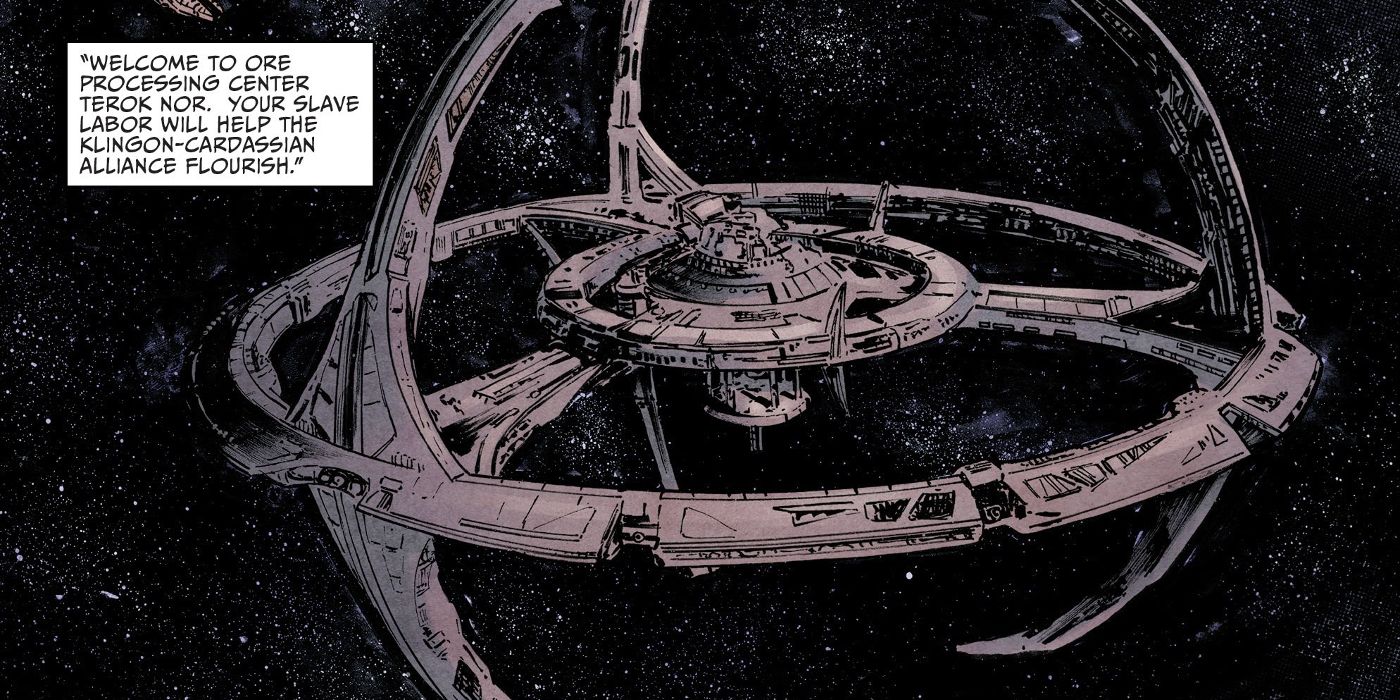
Fans of Star Trek: Deep Space Nine will undoubtedly appreciate future issues of The Mirror War dedicated to Miles' enslavement aboard Terok Nor. In fact, there are many chances for other well-known characters to make an appearance during these issues. Probably the most prominent would be the changeling known as Odo who, despite becoming an ally to Starfleet, began as an impartial outside observer for the Cardassians and Bajorans by settling disputes for both species aboard Terok Nor. He could very well have a similar role in The Mirror War. Additionally, even though the Cardassians used the space station for mining ore, it still housed many shops in a market area known as the Promenade. One of the shop owners who remained on Terok Nor after the Cardassians abandoned the space station is the Ferengi Quark. Aside from his shady dealings, Quark is best known in the show for how he interacted with Odo, annoying him no end.
Of course, the main focus of The Mirror War is the evil Jean-Luc Picard as he endeavors to create a fleet large enough to invade the Star Trek world of his good counterparts. So, the inclusion of Odo and Quark, along with Miles' enslavement on Terok Nor, will undoubtedly be secondary. Nevertheless, there are still possibilities for these disparate Star Trek storylines to collide, especially as Benjamin Sisko has already made a cameo in The Mirror War, and he is more commonly known for serving as captain aboard Deep Space Nine.
Comments
Post a Comment