Furry Jawas Retcons Original Character Designs | Screen Rant

Warning! SPOILERS for The Book of Boba Fett episode 5.

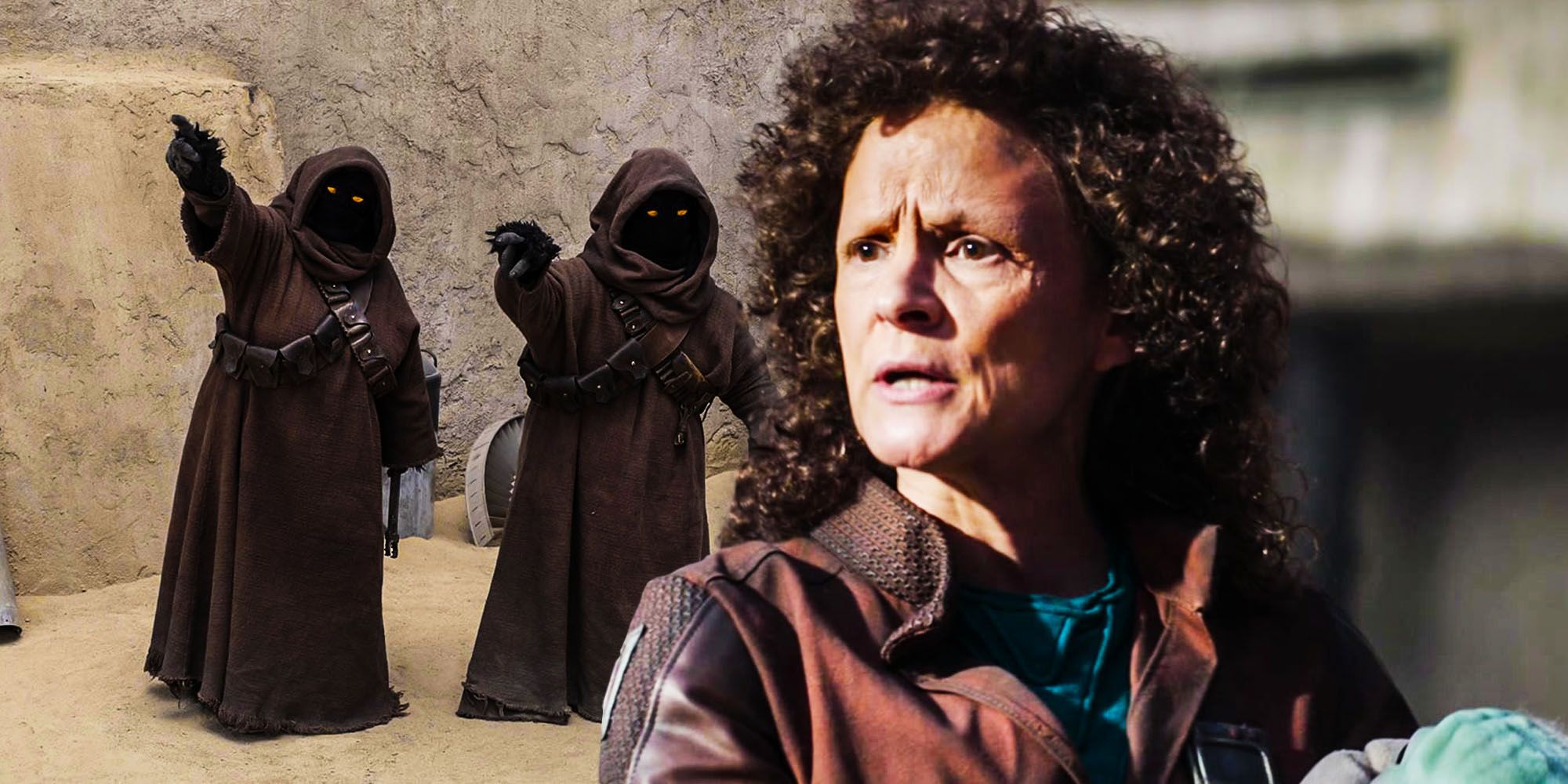
The Book of Boba Fett seems to make an innocent joke about Jawas, but the moment retcons Star Wars' original designs for the characters. In The Book of Boba Fett episode 5, Din Djarin (Pedro Pascal) returns to the Star Wars universe and winds up on Tatooine looking for a ship. Unfortunately, Peli Motto (Amy Sedaris) gets him a vehicle that's not quite up to his Razor Crest standards. Instead, the ship is an N-1 starfighter that's seen better days. However, Din Djarin helps Peli Motto fix up the ship, and the Jawas are the unexpected heroes of the episodes. The little creatures deliver several parts that are pivotal to the final design.

Jawas have a long history in Star Wars. The creatures first show up in A New Hope, selling R2-D2 (Kenny Baker) and C-3PO (Anthony Daniels) to Luke Skywalker (Mark Hamill) and his Uncle Owen (Phil Brown). The creatures repeatedly return in Star Wars' new Disney+ series, playing a significant role in both The Mandalorian and The Book of Boba Fett. In fact, it's because the Jawas want the Mudhorn egg in The Mandalorian season 1 that Grogu/Baby Yoda first shows off his powers.

Related: Who Plays The X-Wing Pilot In Boba Fett? Luke Skywalker Actor Explained

In The Book of Boba Fett episode 5, the series makes a joke about Jawas that seemingly retcons the characters. During the episode, Peli Motto claims she once dated a Jawa. She tells Din Djarin they're "furry" creatures. She later repeats the line for comedic effect. Unfortunately, the comment doesn't fit the Jawas' original designs. In legendary Star Wars concept designer Ralph McQuarrie's sketches, Jawas appear somewhat human-like, with no visible fur. And an unclothed toy Jawa making its way around the internet (via Twitter) was also seemingly missing fur.

If anything, the "furry" comment may shed light on how Disney and Lucasfilm represent Jawas in the future. While the original concept art for Jawas doesn't necessarily showcase furry creatures, the faces are somewhat rodent-like, making fur a possibility for the small humanoids. Additionally, though the drawings didn't emphasize Jawa fur, behind-the-scenes photos (via StarWars.com) reveal that the original Jawa actors appeared to have slightly furry gloves or sleeves under their Jawa robes. Since Peli Motto dated a Jawa and knows them intimately, it seems the Jawas are confirmed to be furry in the Star Wars universe.

Though the revelation that Jawas have a significant amount of fur is somewhat of a retcon from the original concept art, The Book of Boba Fett is all about changing Star Wars' past. After all, if the series didn't retcon Boba Fett's (Temuera Morrison) story, the bounty hunter would've died after he fell into the Sarlacc in 1983's Return of the Jedi. Jawas are already rodent-like in Star Wars, and the new revelation of them being furry simply leans into that description. The slight retcon is also good information for anyone in The Book of Boba Fett looking for Jawa love.

More: Why The Hutts Really Gave The Rancor To Boba Fett - Theory Explained

The Book of Boba Fett streams Wednesdays on Disney+.


Comments

Popular posts from this blog

CBS' Ghosts: Every Main Ghost Time Period & Backstory Explained

One of CBS' newest sitcoms,  Ghosts , features a cast full of spectral characters that each hail from a distinct time period and come with their own unique backstory and death. Though each of the eight ghosts has a wildly different perspective based on their different experiences throughout history, they nonetheless form a sort of family, which is one of the show's greatest charms. After all, being stuck with the same people for all of eternity allows for plenty of time to get to know each other. Ghosts , which is an adaptation of a BBC show of the same name, stars Utkarsh Ambudkar and Rose McIver (who played Liv Moore on five seasons of  iZombie ) as Jay and Sam, a young couple who inherit a mansion in upstate New York. To their surprise, however, the house also comes with several ghostly inhabitants, who Sam is able to see after a near-death experience. These are Thorfinn (Devan Long), Sasappis (Román Zaragoza), Isaac (Brandon Scott Jones), Hetty (Rebecca Wisocky...

The Hateful Eight's Original Ending Explained (& Why Tarantino Changed It)

The Hateful Eight has an ending full of blood and betrayal, as expected from any Quentin Tarantino movie, but this wasn’t the original ending – here’s why he changed it. Tarantino has explored different genres throughout his career; though he’s best known for his crime movies like Reservoir Dogs and Pulp Fiction , he's also visited genres like martial arts (with both Kill Bill  films) and black comedy ( Once Upon a Time in Hollywood ). In addition, he's shared his version of westerns with Django Unchained and The Hateful Eight , with the latter going through some problems and creative changes even before it began shooting. Set in 1870, Tarantino's The  Hateful Eight follows eight strangers, all with different (and secret) motivations, who end up in a stagecoach lodge after seeking refuge from a blizzard. These characters are Major Marquis Warren (Samuel L. Jackson), John “The Hangman” Ruth (Kurt Russell), Daisy Domergue (Jennifer Jason Leigh), Chris Mannix (Walton Gog...

Why Spider-Man 3's Uncle Ben Retcon Doesn't Change Peter's Origin

Sam Raimi’s Spider-Man 3 is often criticized for a major retcon made to Uncle Ben’s death , but this retcon ultimately doesn’t change Peter Parker’s classic origin story. Raimi’s third film in the iconic Spider-Man trilogy is often criticized, perhaps unfairly. While the film suffers from too many character arcs and plot threads and would have been better as two or three separate films, it does a more than adequate job adapting the Spider-Man comics and telling a sincere story about relatable, flawed, characters who are intertwined with the extraordinary, just as Stan Lee and Steve Ditko intended when co-creating the character. Uncle Ben’s retconned death may alter classic elements from the comic version, but it retains its most important aspects in regards to Peter’s characterization. 2002’s Spider-Man is, for much of the film’s first half, a faithful adaptation of Spider-Man’s 1962 origin story in issue 15 of the Amazing Fantasy comics. An awkward social pariah, Pete...