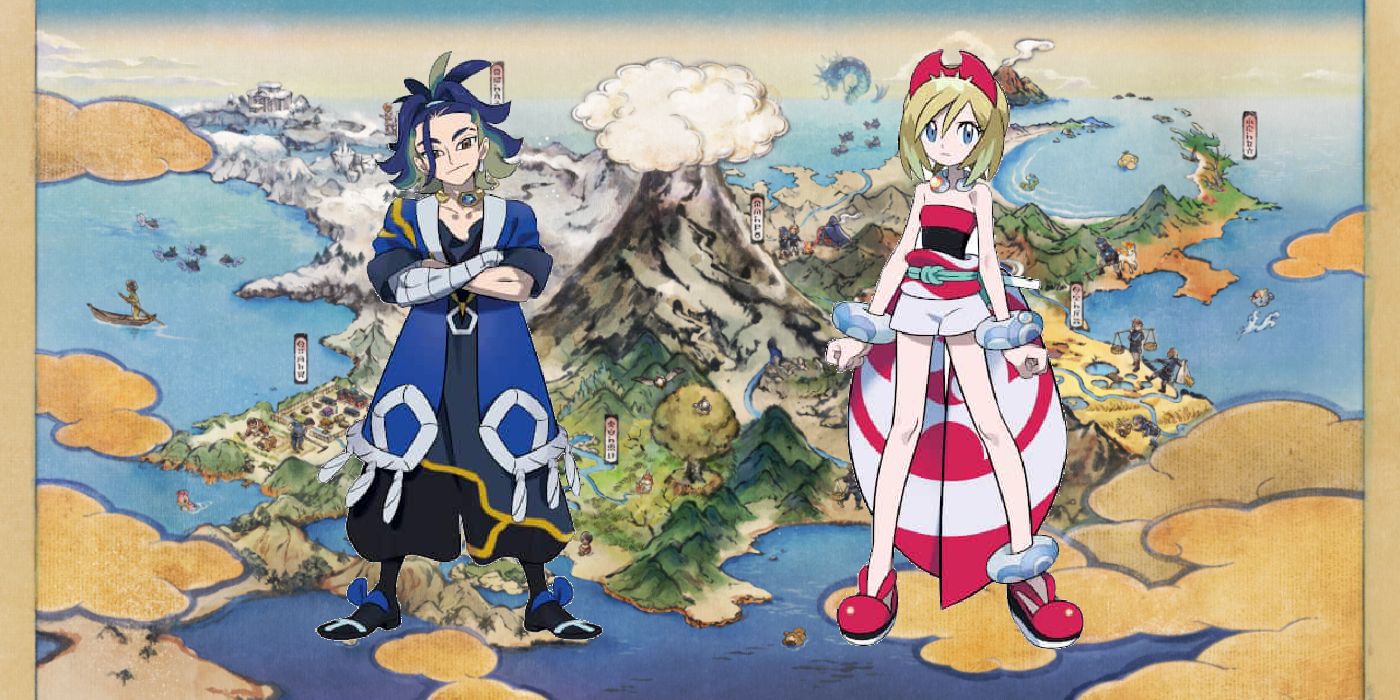
Why Pokémon Legends: Arceus' Hisui Region Isn't Called Sinnoh

Pokémon Legends: Arceus is set in the region that would later become Sinnoh, but in the time the game takes place, the people of the Pokémon world called it Hisui. Legends: Arceus goes to great lengths at setting up how Sinnoh would come to be, but it spends little time explaining how Hisui - or later Sinnoh - earned its name. However, looking at the Japanese meanings of this region's names and the history of the Diamond and Pearl Clans reveals a layered reason behind why the names Hisui and Sinnoh were chosen.

In Pokémon Legends: Arceus, the Diamond and Pearl Clans represent two religious groups who have differing opinions on the god they call "almighty Sinnoh." The Diamond Clan claims this deity Sinnoh created time, while the Pearl Clan claims it created space. Of course, the Pokémon the two groups believe in are Dialga and Palkia respectively, but they do not know this yet and thus believe the other group holds faith in a false deity.

Related: Pokémon Legends: Arceus: What Happens To Volo

This is the major reason why the Hisui region is not called Sinnoh in the game: The Diamond and Pearl Clans only recognize the god they call Sinnoh is actually two gods they can respect together by the ending of Pokémon Legends: Arceus. However, the name Hisui also comes with a lot of its own interesting subtext. Though the origins of the name Hisui are not explained as clearly as what birthed the name Sinnoh, analyzing the Japanese meanings associated with Hisui make it clear that it is the perfect name for the region.

In Japanese, the word hisui has many meanings, several of which are relevant to Pokémon Legends: Arceus. The most significant meanings are "halcyon" and "Sun." Halcyon - which refers to an idyllic time in the distant past - is the perfect name for the game, as Pokémon Legends: Arceus features a beautiful, semi-open world ripe for exploration during the ancient times of Pokémon. "Sun," too is perfect, as the meaning "Sun" specifically refers to the Sun god in Japanese mythology. And with the sun being seen as the giver of life in cultures from across the world, it is fitting to name the region in Legends: Arceus Hisui because Arceus is itself the giver of life in the Pokémon universe.

The names Hisui are fitting for the snowy, myth-laden area they represent. Though the Pokémon games may not choose to explain why these names are chosen, the process of exploring their histories makes them all the more meaningful. It's also a clear way of showing that in Pokémon Legends: Arceus, Sinnoh and Hisui are different

Next: Pokémon Legends: Arceus' Empty Environments Don't Matter


Comments

Popular posts from this blog

CBS' Ghosts: Every Main Ghost Time Period & Backstory Explained

One of CBS' newest sitcoms,  Ghosts , features a cast full of spectral characters that each hail from a distinct time period and come with their own unique backstory and death. Though each of the eight ghosts has a wildly different perspective based on their different experiences throughout history, they nonetheless form a sort of family, which is one of the show's greatest charms. After all, being stuck with the same people for all of eternity allows for plenty of time to get to know each other. Ghosts , which is an adaptation of a BBC show of the same name, stars Utkarsh Ambudkar and Rose McIver (who played Liv Moore on five seasons of  iZombie ) as Jay and Sam, a young couple who inherit a mansion in upstate New York. To their surprise, however, the house also comes with several ghostly inhabitants, who Sam is able to see after a near-death experience. These are Thorfinn (Devan Long), Sasappis (Román Zaragoza), Isaac (Brandon Scott Jones), Hetty (Rebecca Wisocky...

The Hateful Eight's Original Ending Explained (& Why Tarantino Changed It)

The Hateful Eight has an ending full of blood and betrayal, as expected from any Quentin Tarantino movie, but this wasn’t the original ending – here’s why he changed it. Tarantino has explored different genres throughout his career; though he’s best known for his crime movies like Reservoir Dogs and Pulp Fiction , he's also visited genres like martial arts (with both Kill Bill  films) and black comedy ( Once Upon a Time in Hollywood ). In addition, he's shared his version of westerns with Django Unchained and The Hateful Eight , with the latter going through some problems and creative changes even before it began shooting. Set in 1870, Tarantino's The  Hateful Eight follows eight strangers, all with different (and secret) motivations, who end up in a stagecoach lodge after seeking refuge from a blizzard. These characters are Major Marquis Warren (Samuel L. Jackson), John “The Hangman” Ruth (Kurt Russell), Daisy Domergue (Jennifer Jason Leigh), Chris Mannix (Walton Gog...

Why Spider-Man 3's Uncle Ben Retcon Doesn't Change Peter's Origin

Sam Raimi’s Spider-Man 3 is often criticized for a major retcon made to Uncle Ben’s death , but this retcon ultimately doesn’t change Peter Parker’s classic origin story. Raimi’s third film in the iconic Spider-Man trilogy is often criticized, perhaps unfairly. While the film suffers from too many character arcs and plot threads and would have been better as two or three separate films, it does a more than adequate job adapting the Spider-Man comics and telling a sincere story about relatable, flawed, characters who are intertwined with the extraordinary, just as Stan Lee and Steve Ditko intended when co-creating the character. Uncle Ben’s retconned death may alter classic elements from the comic version, but it retains its most important aspects in regards to Peter’s characterization. 2002’s Spider-Man is, for much of the film’s first half, a faithful adaptation of Spider-Man’s 1962 origin story in issue 15 of the Amazing Fantasy comics. An awkward social pariah, Pete...